Difference Betwwenn Beef and Bean Burito and Beef and Bee Chilchuga
Simple changes to letters on restaurants' menus tin double the frequency of customers choosing plant-based options instead of meat, inquiry on the impact of nutrient on the climate crunch has constitute.
The production, transportation and consumption of nutrient has become an increasing focus for climate researchers, with a recent study finding the nutrient industry accounts for more than a tertiary of the world'southward full almanac planet-heating emissions.
Much of the pollution is centered on meat. Raising cattle, chickens and pigs for meat, a process that ofttimes involves clearing large tracts of forest, causes about double the emissions of found-based foods.
Meat consumption remains stubbornly high in the US – the boilerplate American gobbled down 264lb of meat in 2020 – and is rising quickly in countries such as China.
Many people are receptive to the idea of switching to vegetarian options in order to help the environment, however, the enquiry establish, with messaging on restaurant menus a potentially significant way of shifting behaviour.
A multi-stage experiment by the research non-profit organization World Resource Institute (WRI) involved most half-dozen,000 people in the The states and their reaction to carte du jour descriptions.
Researchers tested responses to 10 different sustainability-themed messages when the participants were asked to choose between different options on a menu, such as a bean burrito or beef burrito.
Several of the messages produced dramatic results. Diners who read "Each of united states of america can make a positive deviation for the planet. Swapping simply ane meat dish for a plant-based i saves greenhouse gas emissions that are equivalent to the energy used to charge your phone for two years. Your small change can make a big divergence" on their menus chose a vegetarian dish 25% of the fourth dimension, more than double the rate of diners who were shown no message at all.
Another message – "90% of Americans are making the change to swallow less meat. Join this growing motion and choose plant-based dishes that accept less bear on on the climate and are kinder to the planet" – prompted 22% of people to opt for a found-based dish, again far higher than the standard group.
Other messages, about the taste of the food and the need to protect the planet for future generations, too yielded positive results in choosing vegetarian meals, suggesting that consumers' choices can be significantly shaped by how menus are presented.
"We know behavioral scientific discipline is critical, it really moves the needle," said Edwina Hughes, head of the "cool food pledge", an initiative by WRI and the Un. "Themes of making a modest modify for a big bear upon and also around joining a movement actually boosted the plant-based options."
Hughes said Americans were ready for a "nudge" towards vegetarian options, likening such letters to hotels requesting their guests non need their towels to exist replaced every solar day, every bit a way to save h2o needed to wash them.
"Using descriptive letters that show the benefits of plant-based food choices tin empower people to change their behaviour and choose lower-carbon dishes," Hughes said. "Nosotros tin exercise this because people are primed and gear up for this sort of messaging. They are receptive to seeing letters almost the climate and are actively seeking out brands and logos that point climate-friendly products and services."
WRI researchers said previous attempts to promote vegetarian options had fallen short.
Dishes take functionally been named "vegetarian lasagne" or "meat-free sausages", equally compared with more enticing meat classification such as "grass-fed beef" or "butter-fried chicken".
When dishes are called vegan it "really turns off mainstream audiences. It comes across as preachy, righteous, aggressive," said Jonathan Wise, a consumer researcher who added that more "inclusive" messages could go people to switch more easily to institute-based meals.
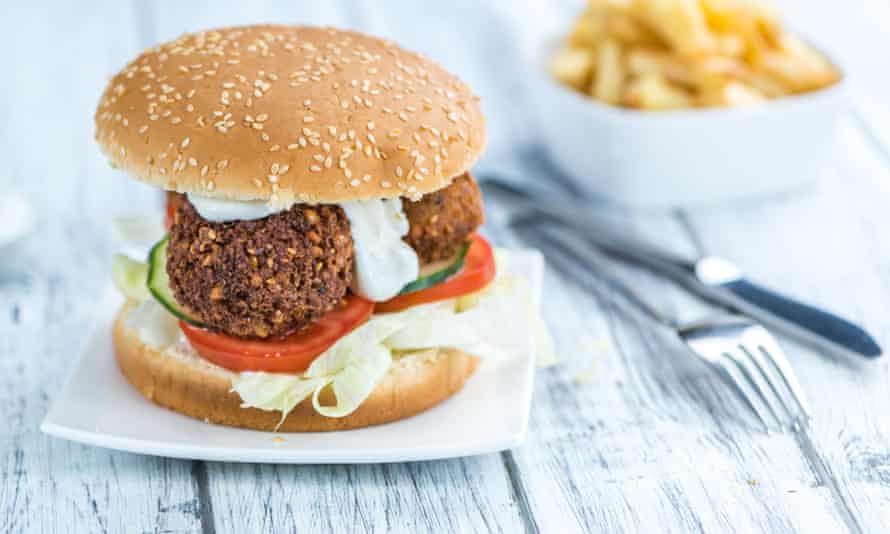
"We launched a falafel burger in 2009, we said it is organic and it'southward for vegetarians – it never sold well and we close it down," said Kaj Torok, principal sustainability officer at Max Burgers, a fast-nutrient company that originated in Sweden. "The main thing we idea was: 'Allow's not just go for this tiny grouping.' It was of import to get for the flexitarians [people who tin skip eating meat] and those people who want to reduce their bear on upon the climate."
Torok said Max Burgers' focus was now taste, rather than whether what'southward beingness served is meat or not, allowing it to drastically increase the number of found-based burgers on menus.
The company is part of WRI's Cool Food Meals scheme, which has seen several food producers, including the Panera Bread chain, agree to disclose the carbon footprint of carte choices.
Such labeling is far from universal, however, with most people unaware of the climate cost of the things they eat. "The time should exist here where we take third-party verification of this," Torok said.
sanchezthromervair.blogspot.com
Source: https://www.theguardian.com/environment/2022/jan/26/plant-based-food-restaurants-climate-menu-messages
0 Response to "Difference Betwwenn Beef and Bean Burito and Beef and Bee Chilchuga"
Post a Comment