African American Version of Norman Rockwell Free From Want Art Lithograph
| Freedom from Desire | |
|---|---|
 | |
| Artist | Norman Rockwell |
| Twelvemonth | 1943 |
| Medium | oil on canvas |
| Dimensions | 116.2 cm × ninety cm (45.75 in × 35.5 in) |
| Location | Norman Rockwell Museum, Stockbridge, Massachusetts, United States |
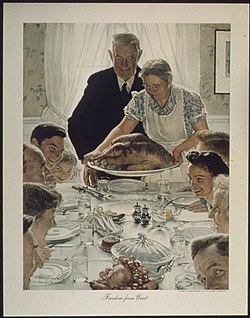
Freedom from Desire , also known as The Thanksgiving Picture or I'll Be Domicile for Christmas , is the third of the Four Freedoms serial of four oil paintings by American artist Norman Rockwell. The works were inspired by Usa President Franklin D. Roosevelt'south 1941 State of the Marriage Address, known as Four Freedoms.
The painting was created in November 1942 and published in the March six, 1943, issue of The Sat Evening Postal service. All of the people in the picture show were friends and family unit of Rockwell in Arlington, Vermont, who were photographed individually and painted into the scene. The work depicts a group of people gathered effectually a dinner table for a holiday meal. Having been partially created on Thanksgiving Day to depict the celebration, it has become an iconic representation for Americans of the Thanksgiving vacation and family holiday gatherings in full general. The Post published Liberty from Want with a corresponding essay by Carlos Bulosan as part of the Four Freedoms serial. Despite many who endured sociopolitical hardships abroad, Bulosan's essay spoke on behalf of those enduring the socioeconomic hardships domestically, and information technology thrust him into prominence.
The painting has had a wide assortment of adaptations, parodies, and other uses, such equally for the encompass for the 1946 book Norman Rockwell, Illustrator. Although the paradigm was popular at the time in the U.s. and remains so, it acquired resentment in Europe where the masses were enduring wartime hardship. Artistically, the work is highly regarded as an instance of mastery of the challenges of white-on-white painting and as one of Rockwell's most famous works.
Background [edit]
The 3rd is freedom from desire—which, translated into globe terms, means economic understandings which volition secure to every nation a healthy peacetime life for its inhabitants—everywhere in the world.
—Roosevelt's 1941 State of the Union address introducing the theme of the 4 Freedoms[1]
Freedom from Desire is the third in a series of four oil paintings entitled Four Freedoms by Norman Rockwell. They were inspired past Franklin D. Roosevelt's State of the Matrimony Address, known equally Four Freedoms, delivered to the 77th United states of america Congress on January 6, 1941.[2] In the early 1940s, Roosevelt'southward Four Freedoms themes were still vague and abstruse to many, but the government used them to assist boost patriotism.[3] The Four Freedoms' theme was eventually incorporated into the Atlantic Charter,[4] [5] and it became part of the charter of the United Nations.[2] The series of paintings ran in The Saturday Evening Post accompanied past essays from noted writers on four sequent weeks: Freedom of Speech (February twenty), Freedom of Worship (February 27), Liberty from Want (March 6), and Freedom from Fear (March 13). Eventually, the series was widely distributed in affiche form and became instrumental in the U.South. Government State of war Bond Drive.[half-dozen]
Description [edit]
The illustration is an oil painting on canvas, measuring 45.75 by 35.5 inches (116.two cm × 90.ii cm). The Norman Rockwell Museum describes it equally a story illustration for The Sat Evening Post, complementary to the theme,[seven] but the paradigm is likewise an autonomous visual expression.[8]
The painting shows an aproned dame presenting a roasted turkey to a family unit of several generations,[nine] in Rockwell's idealistic presentation of family values. The patriarch looks on with fondness and approval from the head of the tabular array,[10] which is the fundamental element of the painting. Its creased tablecloth shows that this is a special occasion for "sharing what nosotros have with those we love", according to Lennie Bennett.[eight] The table has a basin of fruit, celery, pickles, and what appears to be cranberry sauce. In that location is a covered silver serving dish that would traditionally concord potatoes, according to Richard Halpern,[11] but Bennett describes this every bit a covered goulash dish.[8] The servings are less prominent than the presentation of white linen, white plates and water-filled glasses. The people in the painting are not withal eating, and the painting contrasts the empty plates and vacant infinite in their midst with images of overabundance.[12]
Production [edit]
Our melt cooked it, I painted information technology and we ate it. That was one of the few times I've always eaten the model.
—Rockwell[thirteen]
In mid-June Rockwell sketched in charcoal the Four Freedoms and sought commission from the Office of State of war Data (OWI). He was rebuffed by an official who said, "The last war, y'all illustrators did the posters. This war, we're going to utilize fine arts men, real artists."[14] However, Saturday Evening Post editor, Ben Hibbs, recognized the potential of the set up and encouraged Rockwell to produce them right away.[fourteen] Past early fall, the authors for the 4 Freedoms had submitted their essays. Rockwell was concerned that Liberty from Desire did not friction match Bulosan's text. In mid-November, Hibbs wrote Rockwell pleading that he not scrap his third work to start over. Hibbs alleviated Rockwell's thematic business organisation; he explained that the illustrations only needed to accost the aforementioned topic rather than be in unison. Hibbs pressured Rockwell into completing his work by alarm him that the mag was on the verge of being compelled past the government to place restrictions on four-colour printing, and so Rockwell had meliorate go the piece of work published earlier relegation to halftone printing.[15]
In 1942, Rockwell decided to utilize neighbors as models for the series.[16] In Freedom from Want, he used his living room for the setting and relied on neighbors for communication, disquisitional commentary, and their service as his models.[14] For Freedom from Desire, Rockwell photographed his melt as she presented the turkey on Thanksgiving Day 1942.[13] He said that he painted the turkey on that solar day and that, unlike Liberty of Oral communication and Freedom of Worship, this painting was not hard to execute.[17] Rockwell's married woman Mary is in this painting, and the family melt, Mrs. Thaddeus Wheaton,[18] is serving the turkey, which the Rockwell family ate that twenty-four hours.[19] The nine adults and two children depicted were photographed in Rockwell'southward studio and painted into the scene later.[20] [21] The models are (clockwise from Wheaton) Lester Castor, Florence Lindsey, Rockwell's female parent Nancy, Jim Martin, Mr. Wheaton, Mary Rockwell, Charles Lindsey, and the Hoisington children.[13] Jim Martin appears in all iv paintings in the serial.[22] Shirley Hoisington, the girl at the end of the tabular array, was half-dozen at the time.[23]
Later on the Four Freedoms series ran in The Saturday Evening Post, the magazine made sets of reproductions available to the public and received 25,000 orders. Additionally the OWI, which half-dozen months earlier had declined to employ Rockwell to promote the Four Freedoms, requested two.5 million sets of posters featuring the Iv Freedoms for its war-bond drive in early 1943.[24]
Rockwell bequeathed this painting to a custodianship that became the Norman Rockwell Museum in Stockbridge, Massachusetts, and it is now part of the museum'due south permanent collection. Rockwell lived in Stockbridge from 1953 until his death in 1978.[eight]
Reactions [edit]
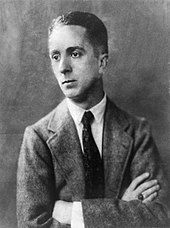
Norman Rockwell early in his career
Freedom from Want is considered ane of Rockwell'south finest works.[20] Of the four paintings in the Four Freedoms, it is the ane most often seen in fine art books with critical review and commentary. Although all were intended to promote patriotism in a time of war, Freedom from Want became a symbol of "family unit togetherness, peace, and plenty", according to Linda Rosenkrantz, who compares information technology to "a 'Hallmark' Christmas".[25] Embodying nostalgia for an enduring American theme of holiday celebration,[26] the painting is not exclusively associated with Thanksgiving, and is sometimes known as I'll Exist Home for Christmas.[27] The affluence and unity information technology shows were the idyllic hope of a post-war world, and the image has been reproduced in various formats.[25]
According to writer Amy Dempsey, during the Common cold State of war, Rockwell's images affirmed traditional American values, depicting Americans as prosperous and free.[28] Rockwell'due south work came to be categorized within fine art movements and styles such as Regionalism and American scene painting. Rockwell's work sometimes displays an arcadian vision of America's rural and agricultural by.[29] Rockwell summed up his own idealism: "I pigment life as I would like it to exist."[xxx]
Despite Rockwell'south general optimism, he had misgivings nearly having depicted such a large turkey when much of Europe was "starving, overrun [and] displaced" as Earth War 2 raged.[21] [31] [32] Rockwell noted that this painting was not popular in Europe:[31] [32] "The Europeans sort of resented it because it wasn't liberty from want, it was overabundance, the table was so loaded down with food."[eleven] Outside the United states of america, this overabundance was the mutual perception.[33] Withal, Richard Halpern says the painting not but displays overabundance of food, but also of "family, conviviality, and security", and opines that "glut rather than mere sufficiency is the true answer to desire." He parallels the emotional nourishment provided by the image to that of the food nourishment that it depicts, remarking that the picture is noticeably inviting. All the same, by depicting the table with zero only empty plates and white dishes on white linen, Rockwell may accept been invoking the Puritan origins of the Thanksgiving vacation.[11]
To art critic Robert Hughes, the painting represents the theme of family continuity, virtue, homeliness, and abundance without extravagance in a Puritan tone, as confirmed past the modest drink option of water.[34] Historian Lizabeth Cohen says that by depicting this freedom every bit a celebration in the private family unit home rather than a worker with a task or a regime protecting the hungry and homeless, Rockwell suggests that ensuring this liberty was not as much a government responsibility as something born from participation in the mass consumer economy.[31]
1 of the notable and artistically challenging elements of the image is Rockwell's use of white-on-white: white plates sitting on a white tablecloth.[eight] [33] Art critic Deborah Solomon describes this as "ane of the most ambitious plays of white-against-white since Whistler'southward Symphony in White, No. i".[35] Solomon farther describes the work as "a new level of descriptive realism. Yet, the painting doesn't experience congested or fussy; information technology is open and airy in the center. Extensive passages of white pigment nicely frame the individual faces."[35]
Jim Martin, positioned in the lower right, gives a coy and perhaps mischievous glance dorsum at the viewer.[35] He is a microcosm of the entire scene in which no one appears to be giving thank you in a traditional fashion of a Thanksgiving dinner.[35] Solomon finds information technology a divergence from previous depictions of Thanksgiving in that the participants do not lower their heads or raise their hands in the traditional poses of prayer. She sees it as an example of treating American traditions in both sanctified and casual ways.[36] Theologian David Brown sees gratitude equally implicit in the painting,[37] while Kenneth Bendiner writes that Rockwell was mindful of the Last Supper and that the painting's perspective echoes its rendition by Tintoretto.[38]
Essay [edit]
Freedom from Want was published with an essay by Carlos Bulosan as part of the Four Freedoms series. Bulosan's essay spoke on behalf of those enduring domestic socioeconomic hardships rather than sociopolitical hardships away, and it thrust him into prominence.[39] [nb 1] Equally he neared his thirtieth birthday, the Philippine immigrant and labor organizer[40] Bulosan was experiencing a life that was non consistent with the theme Rockwell depicted in his version of Freedom From Want. Unknown as a writer, he was subsisting equally a migrant laborer working intermittent jobs.[41] Postal service editors tracked down the impoverished immigrant to request an essay contribution.[42] Bulosan rose to prominence during World War II when the Republic of the Philippines, a U.s.a. territory, was occupied past Nippon. To many Americans, Bulosan's essay marked his introduction, and his proper noun was thereafter well recognized.[39] The essay was lost by The Mail, and Bulosan, who had no carbon copy, had to track down the only draft of the essay at a bar in Tacoma.[41]
Freedom From Want had previously been less entwined in the standard liberalism philosophies of the western earth than the other three freedoms (speech, fear, and religion); this freedom added economic liberty as a societal aspiration.[43] In his essay, Bulosan treats negative liberties as positive liberties by suggesting that Americans be "given equal opportunity to serve themselves and each other co-ordinate to their needs and abilities", an echo of Karl Marx's "from each according to his abilities, to each according to his needs".[44] In the final paragraph of the essay, the phrase "The America we hope to see is non merely a physical but besides a spiritual and intellectual world" describes an egalitarian America.[44] In a vocalisation likened to Steinbeck'due south in works such as The Grapes of Wrath,[41] [43] Bulosan's essay spoke up for those who struggled to survive in the capitalist democracy and was regarded as "haunting and sharp" against the backdrop of Rockwell's feast of plenty. It proposed that while citizens had obligations to the land, the state had an obligation to provide a basic level of subsistence.[41] Unlike Roosevelt, Bulosan presented the case that the New Deal had not already granted liberty from want every bit it did not guarantee Americans the essentials of life.[40]
References in popular culture [edit]
Visual arts [edit]

- The painting was used as the 1946 book cover for Norman Rockwell, Illustrator, written during the prime number of Rockwell's career when he was regarded as America'due south most popular illustrator.[26] This image's iconic condition has led to parody and satire.
- MAD magazine #39 (May 1958) presented a magazine satire chosen "The Saturday Evening Pest",[45] which featured a parody of Freedom from Desire on the cover. In the parody, the family'south circumstances are far from ideal.[46]
- New York painter Frank Moore re-created Rockwell's all-white Americans with an ethnically diverse family unit, every bit Liberty to Share (1994), in which the turkey platter brims over with health care supplies.[47] Among the amend known reproductions is Mickey and Minnie Mouse entertaining their cartoon family with a festive turkey. Several political cartoons and even frozen vegetable advertisements have invoked this image.[33]
- The painting was reenacted in the May 16, 2012, season 3 "Tableau Vivant" episode of the one-act television series Modernistic Family.[48]
- Another fake of the work is the embrace fine art to Tony Bennett'due south 2008 Christmas anthology, A Swingin' Christmas (Featuring The Count Basie Big Band).[49] [50] The parody includes all 13 members of Count Basie'southward ring.[51]
- A promotional poster for the 2018 film, Deadpool two replaced the paintings characters with characters from the flick.[52]
Film [edit]
- A snapshot at the end of the 2002 Walt Disney Feature Animation motion-picture show Lilo & Stitch shows the motion-picture show'due south characters, including some clearly alien life forms, seated at a Thanksgiving table that echoes the painting.[53]
- In the 2009 motion-picture show The Blind Side, when the Touhy family gathers at the Thanksgiving table, the scene is transformed into a replica of the famous painting.[54]
Footnotes [edit]
- ^ The essay is considered one of the author's almost notable works and is compared to John Steinbeck's The Grapes of Wrath.
References [edit]
- ^ "Message To Congress 1941" (PDF). Marist College. Retrieved Baronial 21, 2014.
- ^ a b "100 Documents That Shaped America:President Franklin Roosevelt's Annual Message (Four Freedoms) to Congress (1941)". U.Southward. News & World Written report. U.S. News & Globe Written report, L.P. Archived from the original on Apr 12, 2008. Retrieved April 11, 2008.
- ^ Murray, Stuart & James McCabe (1993). Norman Rockwell'south Iv Freedoms. Gramercy Books. p. 7. ISBN0-517-20213-i.
- ^ Boyd, Kirk (2012). 2048: Humanity's Agreement to Live Together. ReadHowYouWant. p. 12. ISBN978-i-4596-2515-0 . Retrieved August 21, 2014.
- ^ Kern, Gary (2007). The Kravchenko Case: One Man's War on Stalin. Enigma Books. p. 287. ISBN978-1-929631-73-5 . Retrieved August 21, 2014.
- ^ Ngo, Sang (Feb 20, 2013). "And that's the manner it was: February xx, 1943". Columbia Journalism Review . Retrieved January fifteen, 2014.
- ^ "Norman Rockwell (1894–1978), "Freedom from Want," 1943. Oil on canvas, 45 ¾ x 35 ½"". Norman Rockwell Museum. Retrieved December 17, 2013.
- ^ a b c d eastward Bennett, Lennie (November 17, 2012). "'Freedom From Desire' and Norman Rockwell are about more than nostalgia". Tampa Bay Times . Retrieved December 17, 2013.
- ^ Sickels, Robert C. (2004). The 1940s. Greenwood Publishing Group. p. 225. ISBN0-313-31299-0 . Retrieved November 29, 2013.
- ^ Fichner-Rathus, Lois (2012). Understanding Art (10th ed.). Cengage Learning. p. 559. ISBN978-1-111-83695-5 . Retrieved Nov 30, 2013.
- ^ a b c Halpern, Richard (2006). Norman Rockwell: The Underside of Innocence. University of Chicago Printing. p. 72. ISBN0-226-31440-5 . Retrieved November 28, 2013.
- ^ Halpern, Richard (2006). Norman Rockwell: The Underside of Innocence. University of Chicago Printing. pp. 72–73. ISBN0-226-31440-5 . Retrieved Nov 28, 2013.
- ^ a b c Meyer, Susan East. (1981). Norman Rockwell'due south People. Harry N. Abrams. p. 133. ISBN0-8109-1777-seven.
- ^ a b c Fischer, David Hackett (2004). Liberty and Liberty: A Visual History of America's Founding Ideas. Oxford University Press. p. 556. ISBN0-19-516253-6 . Retrieved November 28, 2013.
- ^ Claridge, Laura (2001). "21: The Large Ideas". Norman Rockwell: A Life . Random House. pp. 307–308. ISBN0-375-50453-2.
- ^ "Norman Rockwell in the 1940s: A View of the American Homefront". Norman Rockwell Museum. Archived from the original on July 20, 2007. Retrieved April 12, 2008.
- ^ Hennessey, Maureen Hart & Anne Knutson (1999). "The Four Freedoms". Norman Rockwell: Pictures for the American People. Harry N. Abrams, Inc. with Loftier Museum of Art and Norman Rockwell Museum. p. 100. ISBN0-8109-6392-two.
- ^ Henningsen, Vic (April i, 2013). "Henningsen: The Four Freedoms". Vermont Public Radio. Retrieved December 17, 2013.
- ^ "Honoring the American Spirit" (PDF). Norman Rockwell Museum. Retrieved December 17, 2013.
- ^ a b Solomon, Deborah (2013). "Fifteen: The Four Freedoms (May 1942 to May 1943)". American Mirror: The Life and Art of Norman Rockwell. Farrar, Straus and Giroux. p. 209. ISBN978-0-374-11309-4.
- ^ a b Heitman, Danny (November 27, 2013). "Thanksgiving: A look back at Norman Rockwell'southward iconic illustration 'Freedom From Desire': Deborah Solomon'due south book 'American Mirror' gives a new perspective to one of Rockwell's nigh famous paintings". Christian Science Monitor . Retrieved Dec 17, 2013.
- ^ "I Like To Delight People". Time. June 21, 1943. Retrieved April 7, 2008.
- ^ Murray, Stuart & James McCabe (1993). Norman Rockwell'due south Four Freedoms. Gramercy Books. p. 50. ISBN0-517-20213-1.
- ^ Heydt, Bruce (February 2006). "Norman Rockwell and the 4 Freedoms". America in WWII . Retrieved Dec 17, 2013.
- ^ a b Rosenkrantz, Linda (November 13, 2006). "A Norman Rockwell Thanksgiving". Canton Repository. The Repository. Archived from the original on April 22, 2008. Retrieved Apr seven, 2008.
- ^ a b Guptill, Arthur Fifty. (1972). Norman Rockwell, Illustrator (seventh ed.). Watson-Guptill Publications. pp. cover, vi, 140–149.
- ^ Daniels, Robert L. (December xvi, 2008). "Review: 'Tony Bennett'". Multifariousness . Retrieved June 12, 2014.
- ^ Dempsey, Amy (2002). "1918–1945: American Scene". Fine art in the Modern Era. Harry N. Abrams, Inc. p. 165. ISBN0-8109-4172-4.
During the Cold State of war, Rockwell'due south images of domestic America—solid, dependable, prosperous and, in a higher place all, free—gave a whole generation of Americans an immensely appealing and persuasive view of their traditional values.
- ^ Dempsey, Amy (2002). "1918–1945: American Scene". Art in the Modern Era. Harry N. Abrams, Inc. p. 165. ISBN0-8109-4172-4.
Two defining events of the 1930s, the Great Low and the rise of Fascism in Europe, prompted many American artists to turn away from abstraction and to prefer realistic styles of painting. For Regionalists (see *American Scene), this meant the promotion of an idealized, often chauvinistic vision of America's agrestal past.
- ^ Wright, Tricia (2007). "The Depression and World War Ii". American Art and Artists. HarperCollins Publishers. pp. 122–123. ISBN978-0-06-089124-iv.
- ^ a b c Borgwardt, Elizabeth (2007). A New Deal For The World. Harvard University Press. ISBN978-0-674-28192-9 . Retrieved Nov 28, 2013.
- ^ a b Albisa, Catherine; Martha F. Davis; Cynthia Soohoo, eds. (2007). Bringing Man Rights Home: Portraits of the movement. Praeger Perspectives. p. 33. ISBN978-0-275-98821-0 . Retrieved Nov 28, 2013.
- ^ a b c Hennessey, Maureen Hart; Knutson, Anne (1999). "The Iv Freedoms". Norman Rockwell: Pictures for the American People. Harry North. Abrams, Inc. with High Museum of Art and Norman Rockwell Museum. p. 102. ISBN0-8109-6392-2.
- ^ Hughes, Robert (1997). "The Empire of Signs". American Visions: The Epic History of Art in America . Alfred A. Knopf. pp. 508–509. ISBN0-679-42627-2.
- ^ a b c d Solomon, Deborah (2013). "Fifteen: The Four Freedoms (May 1942 to May 1943)". American Mirror: The Life and Art of Norman Rockwell. Farrar, Straus and Giroux. p. 210. ISBN978-0-374-11309-iv.
- ^ Solomon, Deborah (Oct 2013). "Inside America's Great Romance With Norman Rockwell". Smithsonian Magazine. Retrieved November 27, 2013.
- ^ Brownish, David (February 3, 2011). God and Grace of Torso: Sacrament in Ordinary. Oxford University Press. p. 183. ISBN978-0-19-959996-seven . Retrieved August 21, 2014.
- ^ Bendiner, Kenneth (2004). Food in Painting: From the Renaissance to the Nowadays. Reaktion Books. p. 191. ISBN978-1-86189-213-3 . Retrieved Baronial 21, 2014.
- ^ a b Espiritu, Augusto Fauni (2005). 5 Faces of Exile: The Nation and Filipino American Intellectuals. Stanford Academy Printing. p. fifty. ISBN0-8047-5121-8 . Retrieved November 29, 2013.
- ^ a b Westbrook, Robert B. (1993). "Fighting for the American Family". In Pull a fast one on, Richard Wightman and T. J. Jackson Lears (ed.). The Power of Culture: Critical Essays in American History. Academy of Chicago Press. p. 204. ISBN0-226-25955-ii . Retrieved November thirty, 2013.
- ^ a b c d Saldívar, Ramón David (2006). The Borderlands of Civilisation: Américo Paredes and the Transnational Imaginary. Duke University Press Books. p. 211. ISBN0-8223-3789-4 . Retrieved November xxx, 2013.
- ^ Murray, Stuart & James McCabe (1993). Norman Rockwell'southward 4 Freedoms. Gramercy Books. p. 62. ISBN0-517-20213-1.
- ^ a b Vials, Chris (2009). Realism for the Masses: Aesthetics, Popular Forepart Pluralism, and U.South. Culture, 1935–1947. University Press of Mississippi. p. XXI. ISBN978-1-60473-123-ane . Retrieved November 30, 2013.
- ^ a b Steiner, Michael C. (2013). Regionalists on the Left: Radical Voices from the American Westward. Academy of Oklahoma Printing. p. 307. ISBN978-0-8061-4340-viii . Retrieved Nov 29, 2013.
- ^ "MAD Mag #39 • Usa • 1st Edition - New York". MAD Trash . Retrieved October 16, 2021.
{{cite spider web}}: CS1 maint: url-status (link) - ^ McGowan, Bob (July 26, 2017). "The Fine art of the Post: The Post's Rockwell and MAD's Drucker: Two Great American Artists". The Sabbatum Evening Post . Retrieved October 16, 2021.
{{cite web}}: CS1 maint: url-status (link) - ^ Light-green, Penelope (October 28, 2001). "Mirror, Mirror; Rockwell, Irony-Gratis". The New York Times . Retrieved October 13, 2010.
- ^ Winn, Steven (November 4, 2012). "Norman Rockwell revival at Crocker". San Francisco Chronicle . Retrieved Nov 9, 2012.
- ^ "Tony Bennett: A Swingin' Christmas". AllMusic. Retrieved June 12, 2014.
- ^ Edgar, Sean (December 16, 2008). "Tony Bennett featuring the Count Basie Big Ring: A Swingin' Christmas". Paste . Retrieved June 12, 2014.
- ^ Loudon, Christopher (December 2008). "Tony Bennett: That Holiday Feeling". JazzTimes. Archived from the original on Oct 21, 2015. Retrieved June 12, 2014.
- ^ "Deadpool 2 new promotional affiche". collider.com. Oct ten, 2017. Retrieved October ten, 2017.
- ^ Neighbors, R.C.; Rankin, Sandy (July 27, 2011). The Milky way Is Rated K: Essays on Children's Science Fiction Pic and Idiot box. McFarland. p. 25. ISBN978-0-7864-8801-8.
- ^ "Michael Oher Tells A Whole Dissimilar Story Most 'The Blind Side'". icepop.com. August 9, 2017. Retrieved June nineteen, 2018.
External links [edit]
- Freedom From Want at Norman Rockwell Museum
sanchezthromervair.blogspot.com
Source: https://en.wikipedia.org/wiki/Freedom_from_Want
0 Response to "African American Version of Norman Rockwell Free From Want Art Lithograph"
Post a Comment