Michael Duncan the Los Angeles Art World Regenerative and Needy 4060
On June 7, 1938, a handful of artists in New Mexico, all but one of them having landed there from elsewhere, gathered in Santa Fe at the home of abstract painter Raymond Jonson. Abstraction was then notwithstanding unusual in American art, when the Great Depression encouraged an embrace of Social Realism and American Scene regionalism amid artists, with New Bargain government back up of same via the Works Progress Administration. Abstraction, with its air of European intellectualism and bohemianism, felt out of step with breadlines, Grit Basin deportation and the plight of working class Americans.
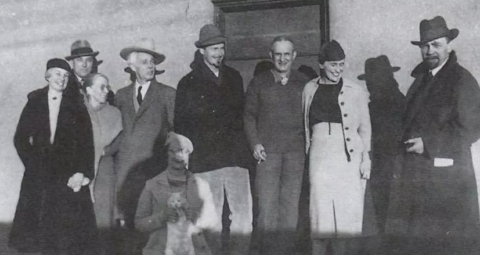 But the artists gathered in Santa Fe, men and women of disparate ages and backgrounds, felt otherwise. As Jonson had written in a letter the previous yr, "I am not interested in telling the farmer and politician about our country but rather in telling near the wonders of a richer and deeper land – the world of peace – love and human being relations projected through pure course." A land, in other words, that lay beyond the American landscape. The artists gathered at Jonson's house were united in their desire to depict another world, i indescribable via traditional western pictorial means. They would instead utilize grade, color and distilled feeling to describe the spiritual world as they perceived it.
Before long organizing under the name the Transcendental Painting Group (TPG), at their second coming together days later the New United mexican states artists elected young man spiritually-minded painter Agnes Pelton as their Honorary President. Pelton, living and working in her own desert town of Cathedral City, California, accustomed. Of their chosen name, Jonson wrote Pelton, "As your non-objective work is a fine case of what I take in listen I should like to know what you think of using the word transcendental to designate information technology instead of abstract or non-objective … Does this discussion seem to you lot to cover the aim of our piece of work insofar as the objective departure and the hope for spiritual content are concerned?"
It did, and a still-underknown motility was born. Another Globe: The Transcendental Painting Grouping is a lavishly illustrated overview of the TPG and its artists, accompanying an exhibition viii years in the making that recently opened at the Albuquerque Museum and will travel to five venues over two years. Pelton is by far the all-time known of the eleven artists in the catalogue and show, though even she is not so well-known, having mostly come to wider attending in just the past few years. It's easy to agree with Michael Duncan, who ushered the exhibition through many years and who contributed the introductory essay and artist biographies to the book, that "the TPG has remained a hush-hush mostly known merely to cognoscenti." According to Duncan, the exhibition/book explicitly "aims to accost this slight."
 The notion of "a undercover known only to cognoscenti" might apply equally to Theosophy, the spiritual engine behind much of the TPG'southward work, and also behind the development of modernist abstraction more often than not. I first heard of Theosophy in the late 1980s, in an art history graduate seminar on Kazimir Malevich – long credited as a pioneer of brainchild (see Black Square) forth with fellow Russian, Wassily Kandinsky – when our professor stopped mid-phrase and said, quite abruptly, something nigh Theosophy beingness "a secret key" to 20th century art, if yous knew where to look. I never forgot what she said and was soon looking for Theosophy, and finding it, everywhere. Information technology was sometimes piece of cake to locate, for instance, in the explicit Theosophical impulse of Piet Mondrian'south paintings, while in other places it was more tenuous, similar Picasso and Braque incorporating the time (time), a great Theosophical preoccupation, in their Cubist works. Later, teaching art history in a Waldorf high school, I discovered the work of Hilma af Klint many years before her recent glory via the blockbuster Guggenheim testify that opened in tardily 2018. Recently credited with creating some of the outset modernist abstract paintings, af Klint was a follower of Rudolph Steiner, the Austrian philosopher who founded Waldorf schools based on the principles of Anthoposophy, which he developed out of Theosophy.
And so it's peradventure both unsurprising and a little odd that a small group of painters in the American desert would, decades after the advent of European abstraction, dedicate themselves to Theosophical aims in painting. Which is non to say that all TPG members took up its rigorous report. As Catherine Whitney succinctly describes in her essay, "Theosophy combined Eastern philosophies, Christian morality, cosmologies, and European occult traditions." In other words, a person might spend a lifetime exploring Theosophical principles, just fortunately the TPG were artists, not theorists. Florence Miller Pierce, the youngest member of the group, said decades afterward, "Nosotros were defenseless up in the language we were exposed to, and the phrase 'quaternary dimension' was bandied about quite a scrap – even though we had no idea what it meant."
While Theosophical ideas tin quickly become wild and woolly, the theorist of the group, Dane Rudhyar, was enviably accessible in his explication of what the TPG sought to do: "They wanted to bear witness that, in the western office of the United States at least, there was a grouping of painters who were conveying more the tradition of not religious but spiritually inclined piece of work, inspired feeling." Rudhyar was born in France (given name, Daniel Chenneviére) and one of the revelations of Another World is discovering that this band of desert mystics – remote and generally forgotten for a fourth dimension – were well-continued to the art globe of their twenty-four hours. From Rudhyar having worked as Rodin's secretary in Paris, to Pelton showing at the 1913 Armory Bear witness, ground zero for the development of American modernism, these were artists eminently in touch with the art of their fourth dimension. Not dabblers who somehow struck on something trippy and absurd in a far-flung backwater, merely educated and aware American artists delving into the same stream of modernist idea equally af Klint, Kandinsky, Malevich, Mondrian, and many others.
How their work stacks upwards against such giants is difficult to appraise in reproduction. Some of it is conspicuously wonderful, fifty-fifty in reproduction – Pelton, Miller Pierce and William Lumpkins are immediately appealing – while others are, at least on the printed folio, uneven. Though Emil Bisttram's The Flaming Ane looks as inspired – and vaginal – as anything by medieval mystic Hildegard von Bingen or feminist artist Judy Chicago, information technology's difficult to imagine his Lord Maitreya gaining gravitas – or much interest – with immediacy and scale. Only I could be wrong. Paintings, specially such spiritually-infused ones, demand to exist experienced in person. I await forward to information technology.
In 1929, Pelton said of her piece of work, "The pictures are like little windows, opening to the view of a region not yet much visited consciously or past intention – an inner realm, rather than an outer landscape." Not yet are the operative words here, even at present. What Another World offers is a rich vein for further exploration, research, inspiration, for artists, writers, historians, poets and anyone else. A window into what's all the same possible and where we might go next.
[Published on July half-dozen, 2021 past DelMonico Books/Crocker Art Museum, 240 pages, $53.00 hardcover. Edited with text by Michael Duncan, text past Scott Shields, MaLin Wilson Powell, Catherine Whitney, Ilene Susan Fort, Dane Rudhyar]
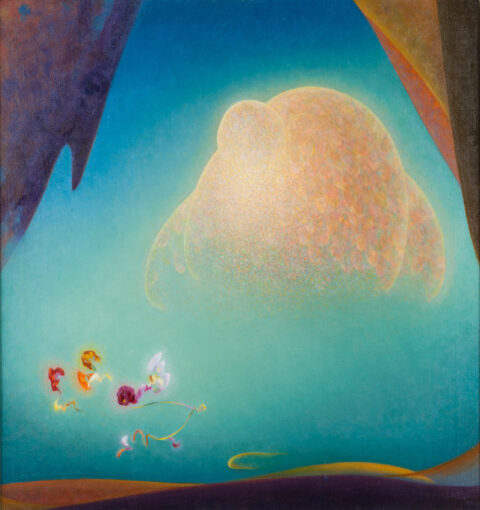
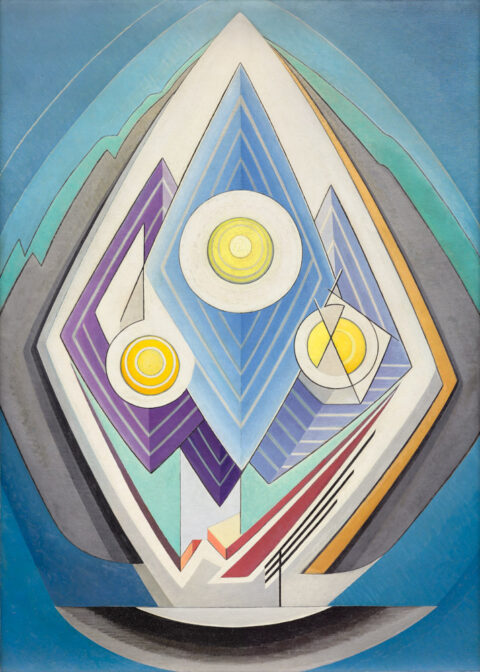
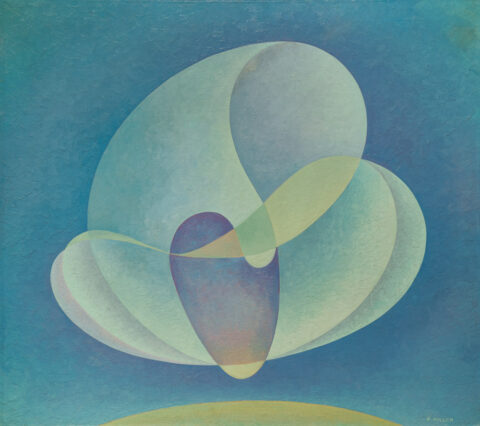
Images shown above and below:
Agnes Pelton, "Nurture," 1940, oil on sheet, 34 3/8 10 32 1/2 inches. Collection of the Nora Eccles Harrison Museum of Art, Utah State University
Lawren Harris, "Painting No. 4," c. 1939, oil on canvass, 51 x 36 5/8 inches, Collection of the Art Gallery of Ontario, Toronto
Florence Pierce, "Bluish Forms," 1942, oil on canvas, 29 3/4 x 34 inches, Georgia & Michael de Havenon, New York
sanchezthromervair.blogspot.com
Source: https://www.ronslate.com/on-another-world-the-transcendental-painting-group-edited-with-text-by-michael-duncan-text-by-scott-shields-malin-wilson-powell-catherine-whitney-ilene-susan-fort-dane-rudhyar/
0 Response to "Michael Duncan the Los Angeles Art World Regenerative and Needy 4060"
Post a Comment